


Master Trading Success With This Mindset Hack: The Psychology of Consistent Profits
Here’s a truth that most trading books won’t tell you: your trading strategy isn’t your biggest problem. Your psychology is.
Study after study shows that traders with mediocre strategies but rock-solid mental discipline outperform traders with brilliant strategies and fragile emotions. The market doesn’t beat most traders. They beat themselves — through fear, greed, overconfidence, and the inability to follow their own rules.
This isn’t about finding the perfect indicator or the holy grail system. It’s about understanding the mental game that separates consistently profitable traders from everyone else.
Here’s the mindset hack that changes everything.

Trading Is 80% Psychological
Markets are neutral. They don’t care about your hopes, fears, or opinions. They’re simply mechanisms for price discovery, driven by supply, demand, and the collective behavior of millions of participants.
But you are not neutral. You bring biases, emotions, and mental shortcuts to every trade. And those internal factors — not the market itself — are what cause most trading failures.
Consider what happens during a typical losing streak:
- Fear causes hesitation, making you miss valid setups
- Revenge trading makes you take impulsive, oversized positions to “get even”
- Overconfidence after a winning streak makes you abandon risk management
- Confirmation bias makes you see only the signals that support your existing position
None of these are strategy problems. They’re psychology problems. And until you address them, no trading system — no matter how sophisticated — will save you.

Emotional Risk vs. Market Risk
Traders often obsess over market risk — volatility, drawdowns, stop losses — while completely ignoring emotional risk. But emotional risk is far more dangerous because it’s invisible and self-inflicted.
The most common emotional risks:
- Fear of being wrong — Causes premature exits, missed entries, and inability to hold winning trades
- Fear of missing out (FOMO) — Causes chasing entries, overtrading, and buying at peaks
- Fear of losing money — Causes moving stops, revenge trading, and position sizing errors
Here’s the key insight: risk is unavoidable, but how you perceive and react to it determines your performance. Markets will always have uncertainty. Your job isn’t to eliminate it — it’s to make peace with it.
You must learn to accept risk emotionally, not just intellectually. You can know rationally that losing trades are part of the game, but if you feel devastated by every loss, your emotions will sabotage your execution.

Beliefs Drive Trading Behavior
Your trading results are a mirror of your beliefs. Not your strategy. Not your analysis. Your beliefs about money, success, control, and self-worth.
Many traders carry destructive limiting beliefs that sabotage them:
- “Losing means failure.” This makes every loss a personal attack, triggering emotional overreactions.
- “I must be right to make money.” This creates perfectionism, hesitation, and the inability to cut losses quickly.
- “The market is out to get me.” This breeds paranoia, overtrading, and conspiracy thinking.
- “I need to recover losses immediately.” This leads to revenge trading, oversized positions, and catastrophic drawdowns.
The mindset hack is this: identify, challenge, and replace these beliefs. Instead of “losing means failure,” adopt “losses are tuition — feedback that improves my process.” Instead of “I must be right,” embrace “I don’t need to predict the market to profit from it.”
Your beliefs aren’t fixed. They’re learned — which means they can be unlearned and replaced with beliefs that serve your trading goals.
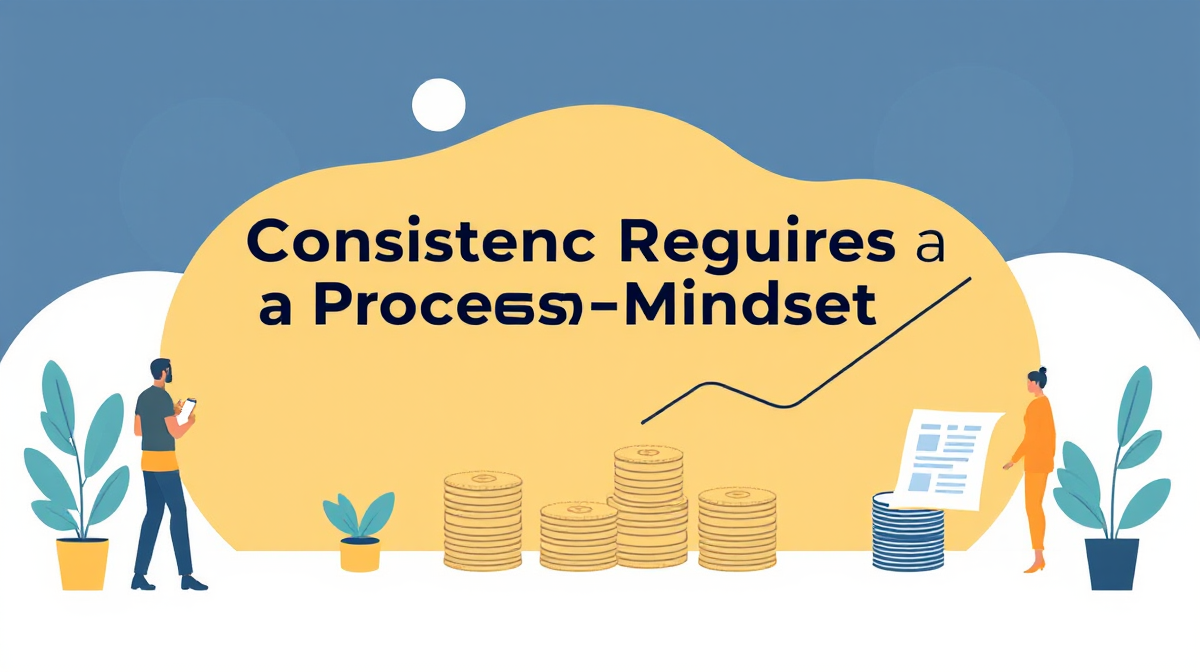
Consistency Requires a Process-Driven Mindset
Here’s what consistently profitable traders have in common: they don’t focus on being right. They focus on executing their plan.
This distinction is subtle but transformative. The outcome-obsessed trader judges every trade by whether it won or lost. The process-driven trader judges every trade by whether they followed their rules.
Why does this matter? Because you can’t control outcomes, but you can control process. A trade can be perfectly executed and still lose money. A trade can be recklessly entered and still profit. Over one trade, outcomes are random. Over one hundred trades, process determines results.
The winning trader’s mindset:
- I follow my rules with emotional neutrality, regardless of the outcome
- Each trade is one data point in a larger statistical edge
- Success comes from probability, repetition, and confidence in my system
Trading is not about predictions — it’s about managing uncertainty.

Developing Self-Discipline and Mental Clarity
Self-discipline in trading isn’t about willpower. It’s about trusting your plan over your impulses. And that trust is built through preparation, practice, and evidence.
Here’s how to build it:
1. Create a Written Trading Plan
Your plan should define exactly what you trade, when you enter, when you exit, how much you risk per trade, and what your daily/weekly loss limits are. Write it down. Make it specific. No ambiguity.
2. Use Checklists
Before every trade, run through a checklist. Is the setup valid? Is position size correct? Is risk within limits? Checklists prevent impulsive decisions and ensure consistency.
3. Detach From Individual Outcomes
Treat each trade as one of a thousand. The outcome of any single trade is irrelevant. What matters is the edge across your next hundred trades.
4. Build Emotional Resilience
Meditation, exercise, sleep, and proper nutrition aren’t soft skills — they’re performance enhancers. Trading is mentally demanding. Your brain needs to be in optimal condition to make rational decisions under pressure.
5. Review, Don’t React
After every trading session, review your trades objectively. Did you follow your rules? What patterns do you see in your mistakes? Use journaling to track emotional states and their impact on performance.

Key Takeaways
- Your beliefs and emotions are your biggest trading obstacles, not the market itself.
- Accepting risk and uncertainty is essential — you can’t eliminate them, only manage them.
- Consistency comes from emotional control and adherence to your strategy.
- Fear of loss and the need to be right must be replaced with process-driven thinking.
- Trading is a mental game that rewards self-awareness and personal growth.
Ready to Master Your Trading Mindset?
The best traders aren’t those with the most complex strategies. They’re the ones who’ve mastered the internal game — who can execute their plan with discipline, accept losses without emotional drama, and treat trading as a probability business rather than an ego contest.
You already have enough knowledge to trade profitably. The question is whether you have the mental framework to apply it consistently.
Want more insights on trading psychology, investing strategy, and financial mastery? Explore The Summary Series by Dominus Code — where we distill the world’s best finance and investing books into actionable wisdom.
This article was inspired by The Disciplined Trader by Mark Douglas — a foundational exploration of the psychology behind consistent trading success and the mental habits that separate winners from losers.