


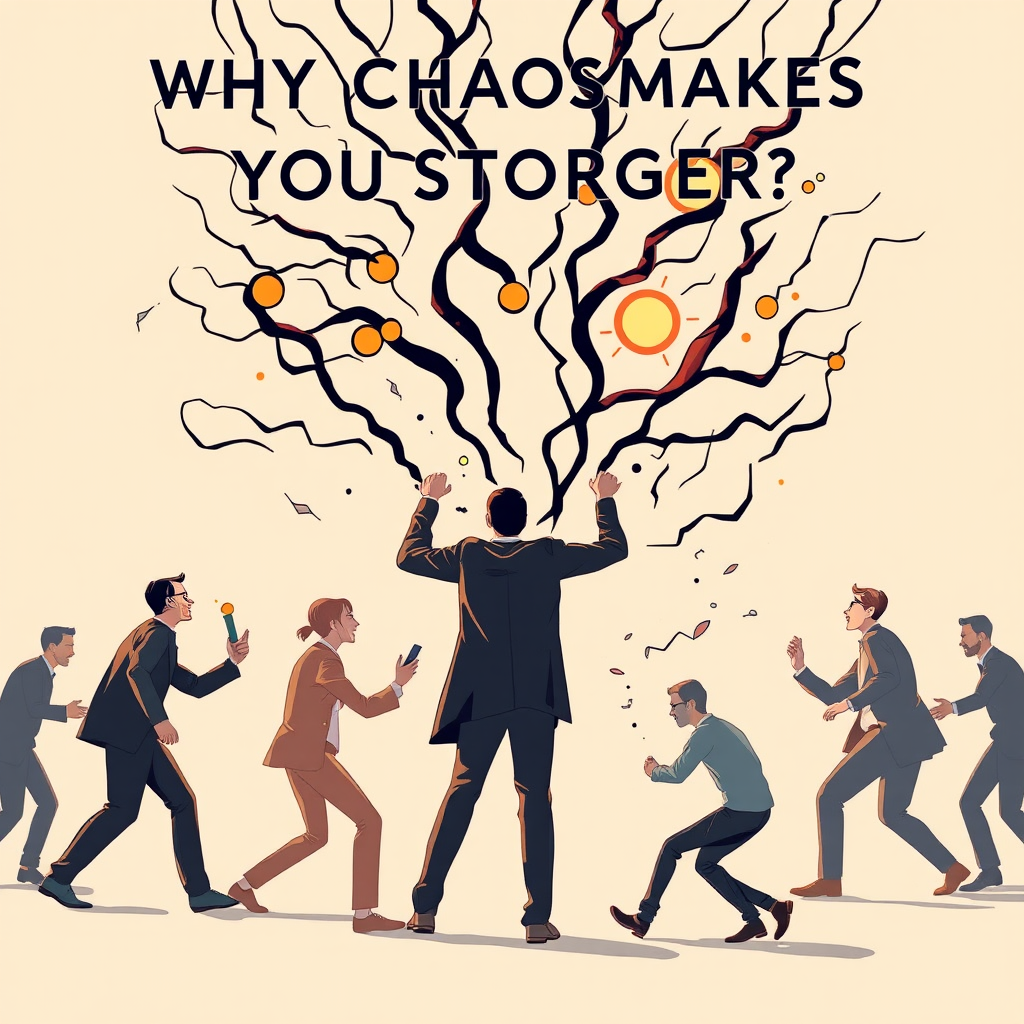
Why Chaos Makes You Stronger (Antifragile Explained)
What if the secrets to building real wealth were hidden in plain sight? In this article, we explore the transformative ideas from Antifragile: Things That Gain from Disorder by Nassim Nicholas Taleb — and how you can apply them to your own financial journey.
Antifragile: Things That Gain from Disorder is the fourth book in Nassim Nicholas Taleb’s Incerto series, following The Black Swan. In this work, Taleb introduces his most important concept yet: antifragility—the property of systems, ideas, or organisms that improve and strengthen when exposed to volatility, shocks, and uncertainty.
If fragility breaks under stress, and robustness resists stress, antifragility goes further—it thrives on stress.

Core Definition: What Is Antifragility?
“Some things benefit from shocks; they thrive and grow when exposed to volatility, randomness, disorder, and stressors.”
- Fragile = Breaks under stress (e.g., glass)
- Robust = Resists stress but stays the same (e.g., rock)
- Antifragile = Grows from stress (e.g., muscles, evolution, entrepreneurship)

Key Concepts and Lessons

1. Barbell Strategy: Embrace Extremes
- Combine extreme safety with extreme risk:
- 90% in safe, stable investments
- 10% in speculative, high-upside opportunities
- Avoid the “middle” where risk is hidden and reward is low.
“The middle is dangerous; it hides fragility.”

2. Via Negativa: Subtraction as Strategy
- Instead of adding complexity or solutions, remove harmful things.
- Examples: Quit smoking, eliminate debt, reduce news consumption.
3. Optionality: The Power of Open-Ended Upside
- Antifragile systems use options—small bets with limited downside and massive upside.
- Think: venture capital, experimentation, trial-and-error.
4. Skin in the Game
- Systems improve when decision-makers share in the risk.
- Fragility arises when people benefit from upside while others bear the cost.
5. The Lindy Effect
- The longer something non-perishable has survived (e.g., a book or idea), the more likely it is to endure.
- Antifragile systems tend to be time-tested.
6. Tinkering Over Planning
- Taleb argues that bottom-up tinkering (trial and error) outperforms top-down forecasting.
- Nature, evolution, and entrepreneurs improve through small failures and constant adjustment.
7. Redundancy and Overcompensation
- Antifragile systems include backup systems, slack, and redundancies (e.g., two kidneys, extra capital).
- This isn’t inefficiency—it’s a buffer against shocks.
8. Overdiagnosis and Overintervention
- Intervening in complex systems often creates more harm than good.
- Examples: Overmedicating patients, unnecessary policies, financial bailouts.
9. Nonlinear Responses and Hidden Fragility
- Real-life systems are nonlinear: small stress can be harmless, large stress catastrophic.
- Systems often appear stable until they suddenly collapse—a key sign of fragility.
Key Takeaways
Fragile things break under stress; antifragile things get stronger
Volatility, randomness, and uncertainty are necessary for progress
Trial and error beats centralized planning
Use optionality and asymmetry to your advantage
Reduce fragility by removing risks, not predicting them
Skin in the game is a moral and functional necessity
Final Thoughts
Antifragile is a profound, provocative guide to building systems, careers, and lives that benefit from chaos instead of breaking down because of it. Taleb’s thinking challenges conventional wisdom in economics, medicine, education, and policy—and offers a new mental model for resilience and growth in an unpredictable world.
Don’t just survive volatility. Use it.
Ready to Learn More?
Want more insights on finance, investing, and wealth-building? Explore The Summary Series by Dominus Code — where we distill the world’s best finance books into practical wisdom.
This article was inspired by Antifragile: Things That Gain from Disorder by Nassim Nicholas Taleb.