

The Secret Empire Behind Modern Finance
What if the secrets to building real wealth were hidden in plain sight? In this article, we explore the transformative ideas from The House of Morgan: An American Banking Dynasty and the Rise of Modern Finance — and how you can apply them to your own financial journey.
“The House of Morgan” by Ron Chernow is a comprehensive history of the Morgan banking empire, detailing its rise, influence, and transformation over 150 years. The book explores how J.P. Morgan & Co. shaped modern finance, influenced global politics, and navigated economic crises from the late 19th century through the late 20th century.
Chernow divides the history of the Morgans into three distinct periods:
- The Baronial Age (1838–1913) – The era of J. Pierpont Morgan, when banking was personal and dominated by elite financiers.
- The Diplomatic Age (1913–1940s) – The Morgans’ role in international finance, war efforts, and government relations.
- The Casino Age (1940s–1980s) – The shift to corporate banking, deregulation, and high-risk financial strategies.

Key Themes & Insights

1. The Rise of J.P. Morgan: The Power of One Man
J. Pierpont Morgan was the most powerful banker of his time, controlling vast financial networks.
He played a central role in stabilizing markets, rescuing banks, and consolidating industries (e.g., U.S. Steel, General Electric).
Morgan acted as an unofficial central bank, stepping in during financial crises, such as the Panic of 1907.
“Morgan wasn’t just a banker—he was a financial ruler, shaping the U.S. economy with his influence.”

2. The Morgans and Global Finance
The Morgans financed wars, governments, and infrastructure projects worldwide.
They helped Britain and France finance World War I, reinforcing their role as global financiers.
Wall Street and Washington grew closer, with Morgan bankers advising U.S. presidents and policymakers.
“The House of Morgan was not just a bank—it was a geopolitical force.”
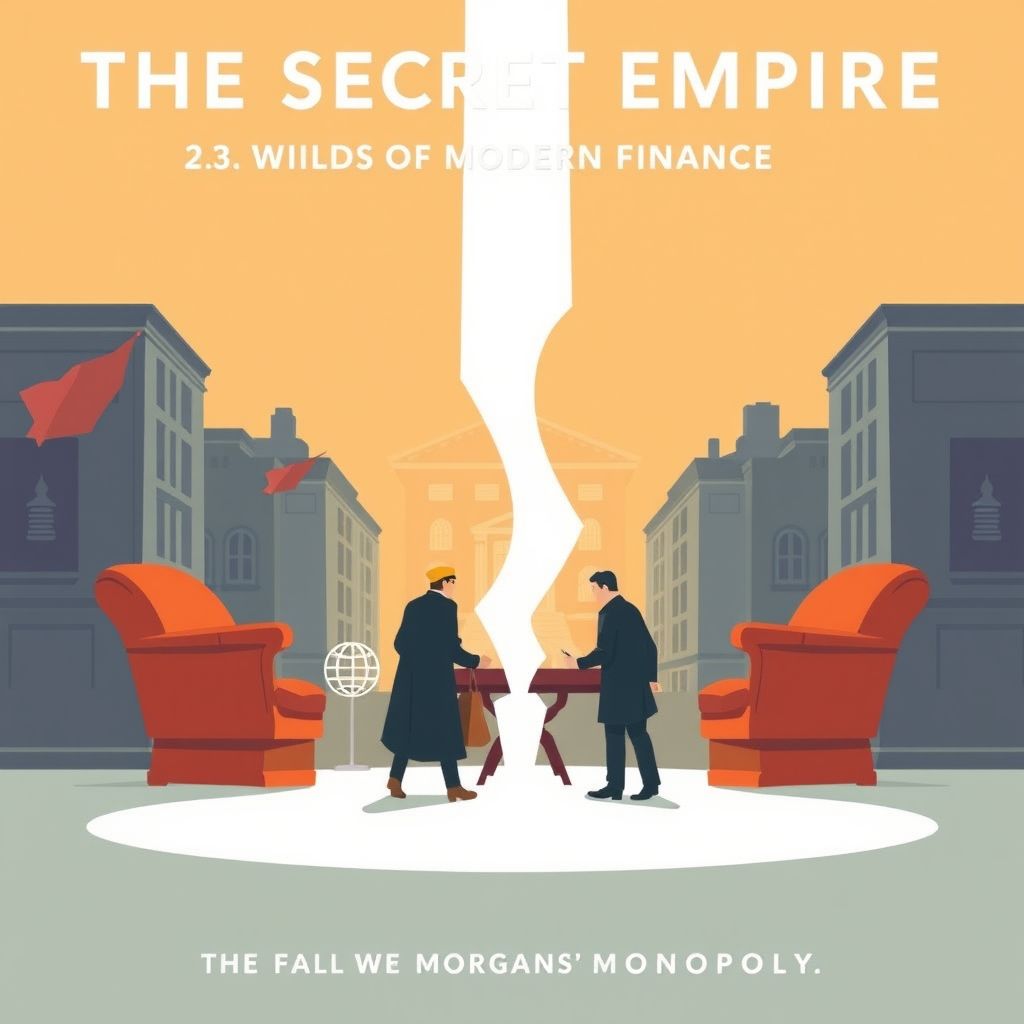
3. The Fall of the Morgans’ Monopoly
The 1913 establishment of the Federal Reserve reduced the power of private bankers like Morgan.
The 1929 stock market crash and Great Depression led to stricter regulations on banking.
The 1933 Glass-Steagall Act forced the Morgans to separate investment banking from commercial banking, breaking up their empire.
“Government regulation and market crashes ended the era of financial titans ruling unchecked.”

4. The Post-War Transformation: From Conservative Banking to Financial Speculation
World War II and post-war growth led to a more bureaucratic, corporate banking culture.
The Morgans’ conservative, relationship-based banking was replaced by aggressive deal-making and speculative finance.
By the 1980s, Wall Street had evolved into a high-risk, high-reward industry, far from its early days of elite banking houses.
“The House of Morgan had to evolve or die in the fast-changing financial world.”
Key Takeaways
J.P. Morgan’s dominance in finance shaped modern capitalism.
The Morgans influenced global politics, war financing, and economic policy.
The Great Depression and government regulation ended private bankers’ unchecked power.
The shift from relationship-based banking to speculation marked the modern financial era.
Wall Street’s transformation reflects the broader evolution of finance—from stability to high-risk capitalism.
Final Thoughts
The House of Morgan is a masterpiece of financial history, offering a fascinating look at how one banking dynasty shaped the modern financial world. Ron Chernow brings to life the personalities, power struggles, and pivotal moments that defined Wall Street.
Ready to Learn More?
Want more insights on finance, investing, and wealth-building? Explore The Summary Series by Dominus Code — where we distill the world’s best finance books into practical wisdom.
This article was inspired by The House of Morgan: An American Banking Dynasty and the Rise of Modern Finance.